Showing posts with label coursework. Show all posts
Showing posts with label coursework. Show all posts
Sunday, November 16, 2008
Initial Ideas
Well, here we are: I've been placed in a group with my peers Nick, Matt and Simon, and we've begun brainstorming ideas for the film opening which we will make. Nick and Simon already seem to have a whole mountain of ideas, mainly an idea for a film noir style opening featuring a dramatic confrontation in a dark alleyway, with a voiceover by the hero. This sounds exciting enough, and seeing as I haven't come to the table with any good ideas of my own, I'm willing to entertain this idea. However, looks like I'll be researching film noir in the next few weeks.

Tuesday, November 4, 2008
Research: famous film production logos
Some films use world renowned film production logos at the start of films as an introduction to the film. This also can include TV series, e.g. Futurama and its "30th Century Fox" opening, a tongue in cheek reference to 2oth Century Fox's dynamic theme and logo.
Another example is at the start of the film "The Core," in which its subject matter of the Earth's core is introduced by the familiar "Paramount Pictures" opening, when suddenly the camera arcs over as it zooms in on the Paramount mountain, then the shot takes a plummet down a crevasse, down, down, down, into the seething magma of the Earth's core. These type of productions use the fact that the introductory themes and logos of these producers are so traditional and well known that the directors can use them to turn things on their heads and make the familiar unfamiliar, but also making it more accessible to the audience.
Another example is at the start of the film "The Core," in which its subject matter of the Earth's core is introduced by the familiar "Paramount Pictures" opening, when suddenly the camera arcs over as it zooms in on the Paramount mountain, then the shot takes a plummet down a crevasse, down, down, down, into the seething magma of the Earth's core. These type of productions use the fact that the introductory themes and logos of these producers are so traditional and well known that the directors can use them to turn things on their heads and make the familiar unfamiliar, but also making it more accessible to the audience.
Researching movie posters
I'm looking at a selection of movie posters for Pirates of the Caribbean: Curse of the Black Pearl. This poster shows how the imagery of the genre generates interest and attracts an audience to the film. The potential viewers will automatically associate the skull and crossbones and daggers with pirates and thus pirate films, to the point that they have merged the two images. The mystery surrounding this, as no information is given other than the release date and the image, creates suspense and interest in the film.
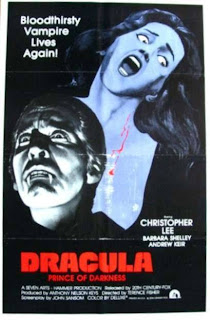 This poster for Dracula: Prince of Darkness relys on the established fame and set pieces (e.g. Christopher Lee, beautiful women meeting nasty ends) of the series and its star to attract the audience that has seen the previous Dracula films.
 However, posters that came out later in the advertising campaign focused much more on the stars of the film. At the risk of being cynical, I point out that these posters also do not show much about the plot other than dynamic imagery, this time of the stars that will appear in the film. They rely on the fame of the lead actors to create interest in the film.

The advertisers rely on the fame of the actor, and then create an intense and dynamic background to excite the audience.
However, if the film is a sequel, part of an established series, the name of the series and an image of the star of that series are familiar enough to introduce the film, and the film merely has to be shown to be as exciting and dynamic as its predecessors.
 This poster for Dracula: Prince of Darkness relys on the established fame and set pieces (e.g. Christopher Lee, beautiful women meeting nasty ends) of the series and its star to attract the audience that has seen the previous Dracula films.
Research: Scripting
Just looking at different types of script here. The differences in script style between a television script and a movie script shed light on the differences in production, and what makes them different.
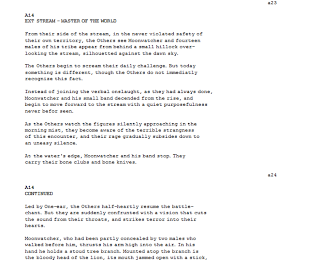
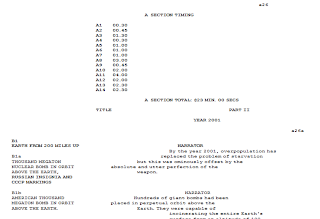
These screenshots from a movie script (2001: A Space Odyssey) show the huge emphasis on explicit direction in the script. There are large chunks written describing each individual shot. The script does not actually describe the shot, but gives a huge amount of plot detail, telling the story as it would be in a book. From this, the director creates a scene, with appropriate direction based on the story as they have been told in the script. The scripr then directs how long each shot and the the section as a whole are expected to last. This means that the director knows how much time to aim to show the scene in.
The dialogue of the script runs down the centre of the page, while the images that are going to be displayed during this are shown to the left. Thus the director, reading the script, can match the scene directions up to the scripted speech.
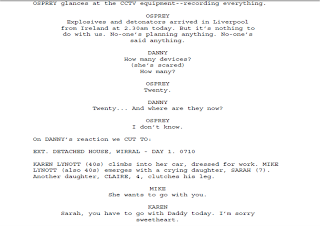
In this extract from a television script (Spooks) the differences are obvious. The directions are much more concise and to the point, giving the scene, the people and objects in it, and the ages of any characters introduced in the shot. This is followed by the dialogue of the characters as scripted, with the action interspersed as it happens in the scene. This means that the director and actors already know when events happen within a scene.
This shows that movie directors are given much more responsibility within exactly what happens within a scene and when, and that, more importantly, they are allowed a larger interpretation of the narrative. In comparison, television directors have a less prominent job, but still have an important task in set design, deciding on the "look" of the set, and the type of shots used in the scene. It is worth noting that movie directors usually achieve far greater fame than those in television.


These screenshots from a movie script (2001: A Space Odyssey) show the huge emphasis on explicit direction in the script. There are large chunks written describing each individual shot. The script does not actually describe the shot, but gives a huge amount of plot detail, telling the story as it would be in a book. From this, the director creates a scene, with appropriate direction based on the story as they have been told in the script. The scripr then directs how long each shot and the the section as a whole are expected to last. This means that the director knows how much time to aim to show the scene in.
The dialogue of the script runs down the centre of the page, while the images that are going to be displayed during this are shown to the left. Thus the director, reading the script, can match the scene directions up to the scripted speech.

In this extract from a television script (Spooks) the differences are obvious. The directions are much more concise and to the point, giving the scene, the people and objects in it, and the ages of any characters introduced in the shot. This is followed by the dialogue of the characters as scripted, with the action interspersed as it happens in the scene. This means that the director and actors already know when events happen within a scene.
This shows that movie directors are given much more responsibility within exactly what happens within a scene and when, and that, more importantly, they are allowed a larger interpretation of the narrative. In comparison, television directors have a less prominent job, but still have an important task in set design, deciding on the "look" of the set, and the type of shots used in the scene. It is worth noting that movie directors usually achieve far greater fame than those in television.
Subscribe to:
Posts (Atom)
